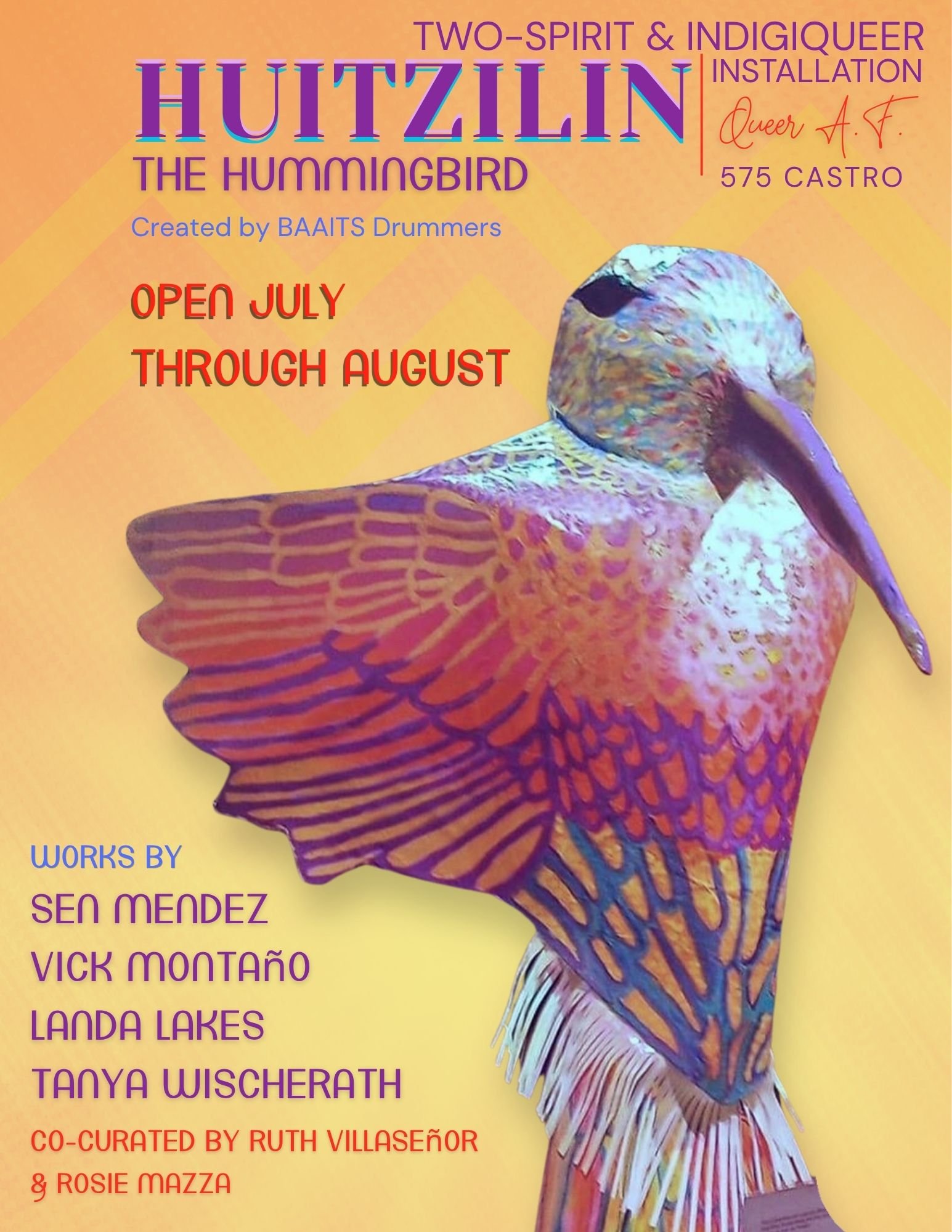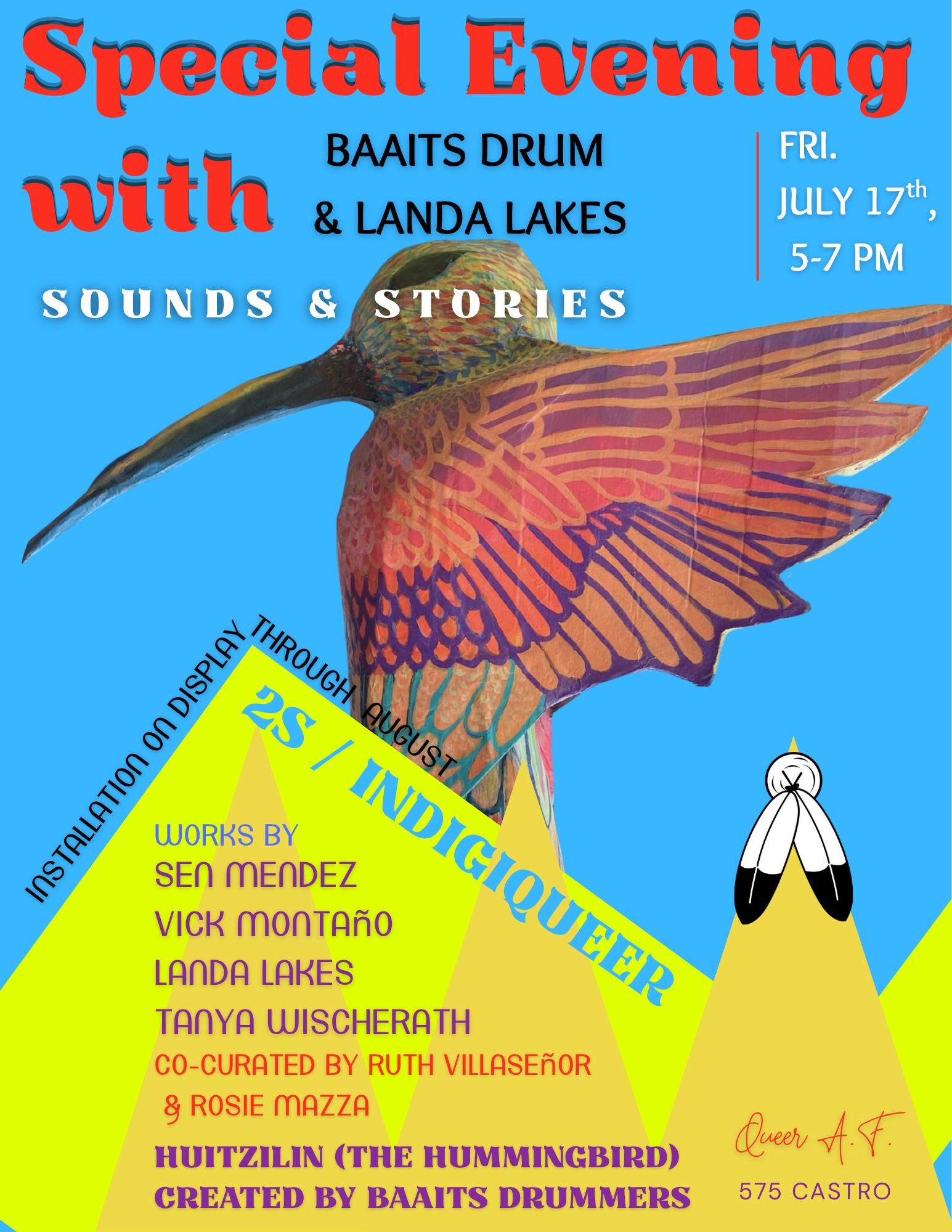
HUITZILIN : The Hummingbird
ON DISPLAY NOW THROUGH AUGUST ‘26
Huitzilin Installation, 2026
In Nahuatl it is called huitzilin. In dozens of other Native languages it carries dozens of other names, and in nearly all of them it is treated as something sacred: a messenger, a healer, a reminder that the boundary between the living and the ancestors is thinner than it looks.
This exhibit, anchored by the drummers and artists of BAAITS (the Bay Area American Indian Two Spirit) drum group’s Huitzilin (hummingbird) paper mache sculpture, we borrow this small guide for the journey ahead.
On the terms used, and the words we are still finding
Two of the terms you will see throughout this installation are "Two-Spirit" and "Indigiqueer." Both are useful. Both are also, by design, incomplete, and that is worth saying plainly.
"Two-Spirit" was coined in 1990 at an intertribal gathering in Winnipeg, offered in English and then echoed in Anishinaabemowin as niizh manidoowag, "two spirits." It was never meant to describe one tradition. It was built on purpose as a shared, pan-tribal umbrella term so that Native people across hundreds of distinct nations, each with their own much older words and roles for gender-expansive and same-sex-loving relatives, could stand together in public life and in ceremony without being flattened into the derogatory anthropological label that had been used to describe them for over a century. The term “Two-Spirit” (conceived by Two-Spirit people) prefer non-indigenous people not to use this term to describe themselves. It is a gift, and it is also a translation, which means something is always lost in the carrying. Even the word "two" can quietly nod back toward the binary it is trying to move past, as if there were only two spirits to combine in the first place. Most nations never thought in twos to begin with.
"Indigiqueer," coined more recently by Cree artist Theo Cuthand, exists for a related but different reason: for those who feel closer to contemporary queerness than to the specific spiritual framing of "Two-Spirit," or whose nation's own traditions do not map onto it cleanly. It is younger, more flexible, and still, like its sibling term, an umbrella raised over a forest of distinct languages and lifeways.
We offer both terms with full awareness that it was tailored for general use, not for any one body in particular. The real fit was always the nation-specific names, roles, and ceremonies that predate either English term by centuries, many of which BAAITS members carry forward in their own communities right now.
BAAITS
In 1999, a small group of volunteers in the Bay Area, including Gene Hightower, Morningstar Vancil, Laura Oropesa, Ken Harper, and Ruth Villaseñor, came together to host an international Two-Spirit gathering after Beverly Little Thunder put out the call for organizers the year before. It was Sally Ramon who, in one of those early planning meetings, gave the group its name: Bay Area American Indian Two-Spirits. The organization started as a sober, prayer-centered space, open to any self-identified American Indian willing to show up and build something together democratically.
What began as a gathering grew into a standing community, one whose stated purpose has always been to restore and recover the roles of Two-Spirit and Indigiqueer people within American Indian and First Nations communities, not to invent those roles from nothing. That distinction matters to us. BAAITS, like the terms it organizes under, is a vessel built in recent memory to hold something far older: the specific, sovereign traditions of Yaqui, Zapotec, Pomo, Coastal Miwok, Ohlone, and hundreds of other nations, each of whom already had their own language for the relatives gathered here long before anyone needed a Bay Area address to find each other.
The Hummingbird
Huitzilin is small, fierce, and shimmers in light depending on the angle you catch it from, which has made it a natural emblem for people whose gender or spirit has never sat still inside one fixed category either. Long before colonization introduced a strict gender binary to this continent, gender-expansive and same-sex-loving people held respected, often essential roles: healers, visionaries, namers, keepers of ceremony. The hummingbird's restlessness, its refusal to be only one thing, was already a fitting mirror.
This exhibit also happens to land near the United States' 250th anniversary, a small fraction of time for the traditions on display here.
With love, gratitude, and respect,
Queer Arts Featured